

Business Operation · 2025
In this section22 topics
- Corporate Information4 items
- Dividend Policy2 items
- Major Shareholders1 item
- Business Strategies Overview4 items
- Material Changes & Developments1 item
- Use of Proceeds from Securities Offerings1 item
- Commitments Made in the Registration Statement1 item
- Group Operating-Structure Policy1 item
- Companies Where the Company Holds ≥10%1 item
- Shareholders with Potential Conflict of Interest1 item
- Relationships Among Major Shareholders2 items
- Shareholders' Agreement1 item
- Shareholding Diagram (Group Structure)3 items
- Income Structure3 items
- Product / Service Characteristics2 items
- Research & Development2 items
- Assets Used in the Business4 items
- Marketing Policy & Competition3 items
- Procurement of Products & Services5 items
- Projects Under Construction7 items
- Debentures & Bills of Exchange1 item
- Convertible Securities1 item
Corporate Information
Company Name
STAR PETROLEUM REFINING PUBLIC COMPANY LIMITED
Telephone
0-3869-9000
Website
www.sprc.co.th
ir@sprc.co.th
Dividend Policy
Dividend Policy
The dividend payment policy of SPRC aims to distribute dividend twice per year of at least 50 percent of net profits (excluding unrealized stock gain (loss)) after the allocation of legal reserve. The payments are subjected to the current and projected cash flows, market conditions, capital requirements and other considerations as our board of directors may deem relevant.
The dividend declaration shall be made in US Dollar and converted to Thai Baht by using the average selling exchange rate of the Bank of Thailand for 7 banking days before the date of notice of the board of directors meeting for consideration on the dividend payment. Our board of directors may recommend an annual dividend payment, subject to the approval of our shareholders at the shareholders’ meeting.
Our board of directors may also, by its resolution, decide to pay the interim dividends to our shareholders if the directors determine that it is justified by our profits and retained earnings. It is the policy of our board of directors to consider the interim dividend payments to our shareholders every year.
Historical Dividend Payments
| This Year | Last Year | 2 Years Ago | 3 Years Ago | 4 Years Ago | Metric | Description | Remark |
|---|---|---|---|---|---|---|---|
| 0.59 | 0.52 | -0.22 | 1.77 | 1.09 | Net profit per share (Baht : Share) | Net profit per share (baht : share) | |
| 0.45 | 0.4 | 0 | 1.11 | 0.18 | Dividend per share (Baht : Share) | Dividend per share (baht : share) | 1. The Company paid the total annual dividend payment in 2021 Baht 0.1785 per share from Company’s unappropriated retained earnings as of 31 December 2021.
2. The Company paid the total annual dividend payment in 2022 Baht 1.11 per share from 2022 Company’s performance.
3. The Company paid the total annual dividend payment in 2024 Baht 0.40 per share from 2024 Company’s performance.
4. The Company paid the total annual dividend payment in 2025 Baht 0.45 per share from 2025 Company’s performance pending approval at the 2026 Annual General Meeting of Shareholder (AGM). |
| 0 | 0 | 0 | 0 | 0 | Dividend stock ratio (Number of original shares: dividend shares) | Ratio of stock dividend payment (existing share : stock dividend) | |
| 0 | 0 | 0 | 0 | 0 | Dividend share value per share (Baht : Share) | Value of stock dividend per share (baht : share) | |
| 0.45 | 0.4 | 0 | 1.11 | 0.18 | Total dividend payment value (Baht : Share) | Total dividend payment (baht : share) | |
| 79 | 83 | 0 | 61 | 16 | Dividend payout ratio to net profit (%) | Dividend payout ratio compared to net profit (%) |
Business Strategies Overview
Vision
Our Vision: “One Caring Family … Energizing Our Future”
One Caring Family is the DNA of our SPRC culture and the foundation of all our activities. We care for our employees, contractors, communities, and all stakeholder groups as members of our extended family. We are committed to safety, reliability, environmental stewardship, and sustainable development in every aspect of our operations.
This culture is grounded in our Core Values and in our firm commitment to be Incident and Injury Free (IIF) throughout our business. We continue to extend and reinforce this culture with our stakeholders in the surrounding community and across our value chain.
Objectives
To energize our future, we will:
Invest in our people, enhancing SPRC’s caring family culture and performance delivery
Deliver safe, reliable, and sustainable operations
Strengthen our competitiveness through smart & timely investments
Meet or exceed our stakeholder expectations
Goals
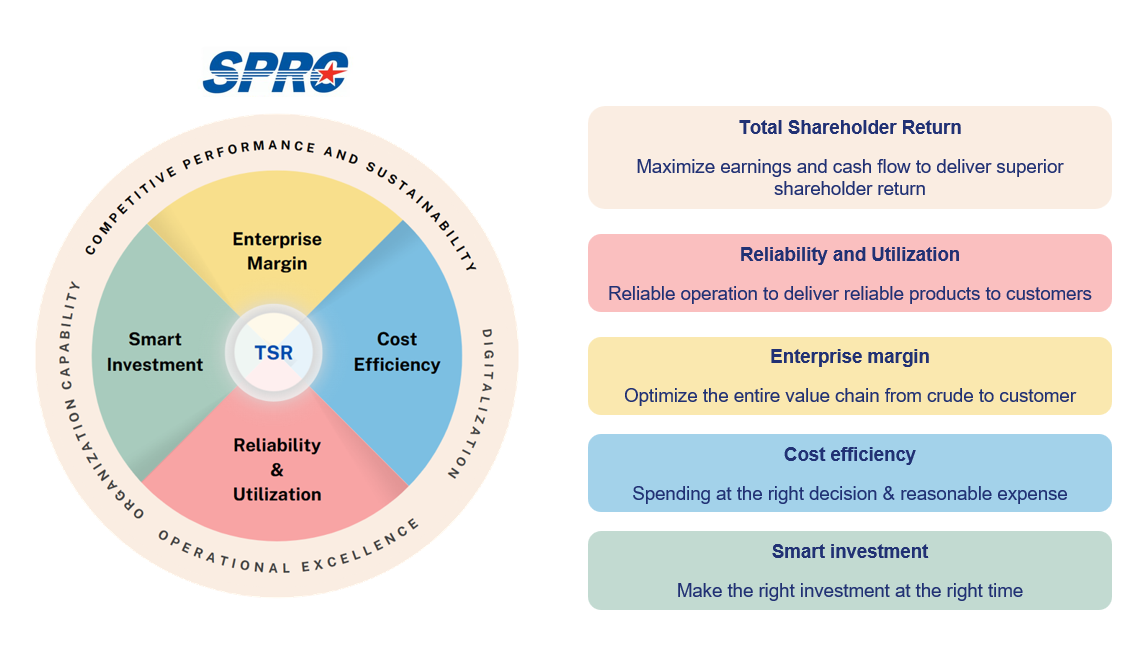
SPRC’s goal to remain competitive is to deliver strong Total Shareholder Return (TSR), which means generating profitability as well as maintaining solid cash flow and liquidity in order to consistently create high returns for shareholders.
Business Strategies
Our Strategy: is to deliver competitive performance and sustain the financial strength to maximize shareholder returns for sustainable long-term success.
Maintaining a strong financial position is essential for providing a reliable dividend and for seizing new opportunities through strategic investments.
We will achieve “Optimizing Value Chain and Strategic Growth in Cash Generation” strategy through two core initiatives.
We focus on safety and reliable optimization of our refining and marketing value chain.
We are enhancing cash generation through the profitable growth of our marketing business.
Our Key Focus Areas: We accelerate strategy to deliver more value and enhance our competitiveness and financial strength through below pillars:
Reliability and Utilization: Reliable operation to deliver reliable products to customers, and optimum utilization to maximize margin
Enterprise Margin: Maximize margin through the entire value chain optimization from crude to customer
Cost Efficiency: Spending at the right decision with reasonable resources we consumed to achieve desired outcomes and stay competitive
Smart investment: Make discipline right investment at the right time
The right balance of these key foundations are integrated with four enablers of competitive performance and sustainability, digitalization, operational excellence, organization capability measures.
This ultimately makes SPRC even more competitive, resilient and winning in all situations.
The Board of Directors conducts a comprehensive annual review of the vision, mission, business strategy, organizational goals, and plans to ensure continued relevance, alignment with the prevailing business environment as well as support the company's long-term objectives.
At the Board of Directors meeting No. 4/2025, the Board approved amendments to the company's vision, mission, and business strategy. The new vision, mission, and business strategy will be effective from January 1, 2026.
Furthermore, during each quarterly Board of Directors meeting, management provides updates to the Board on the progress of strategic projects and the implementation of the company's plans.
Material Changes & Developments
Material Changes & Developments
| Year | Description |
|---|---|
| 2,024 |
On 3 January 2024, the Fuel Business Investment Transaction, involving the acquisition of shares and associated strategic assets from Chevron Asia Pacific Holdings Limited (CAPHL), has been successfully completed. The acquisition of the Fuel Business is expected to enhance the Company’s value chain as a fully integrated refining and marketing business in Thailand. Following the integration, the Commercial Business continues to create value with partnership to strengthen the brand positioning and broadly expand the customer base throughout Thailand. Apart from fuel service station network expansion, it also places emphasis on expanding our non-oil offerings to enhance customers’ satisfaction by partnering with strategic retail partners including convenience stores, restaurants, coffee shops, and car repair and car care service centers.
In July 2024, the Company received the relevant written regulatory approvals to resume operations at the offshore Single Point Mooring (SPM), located 20 km southeast of Map Ta Phut Industrial Estate in the Gulf of Thailand. Starting from 14 July 2024, the Company has resumed SPM operations. |
| 2,025 |
|
| 2,023 |
On January 31, 2023, the Extraordinary General Meeting of Shareholders No. 1/2023 of the Company approved the acquisition of investments in the fuel business. The Company has entered into an agreement to purchase 100% of the share capital of Star Fuels Marketing Company Limited (SFL) for US$16.8 million and 9.91% of the share capital of Thai Petroleum Pipeline Company Limited (Thappline) for US$45 million from Chevron Asia Pacific Holdings Limited. Additionally, a subsidiary of the Company has acquired the land used for petroleum product distribution for US$28.2 million. The total value of the Fuel Business Investment Transaction amounts to US$90 million.
The Company is one of twelve to sign the MOU for the "Driving to Net Zero EEC" pilot project to promote environmentally-friendly investment, establish an emissions trading scheme, and support carbon credit trading in the EEC areas. |
Use of Proceeds from Securities Offerings
Is There Money Raised from a Securities Offering Still to Report On?
No
Commitments Made in the Registration Statement
Are There Commitments or Conditions from an Offering or Listing?
No
Group Operating-Structure Policy
Description
In terms of corporate governance, the Board of Directors has established guidelines for the governance of subsidiaries and associated companies by appointing representatives of the Company to serve as directors of subsidiaries and associated companies in proportion to the Company’s shareholding. Such representatives of the Company are senior executives nominated to serve as directors of associated companies, and such nominations must be approved by the Board of Directors.
The Company’s representatives who serve as directors of subsidiaries and associated companies are responsible for acting in the best interests of the subsidiaries and associated companies, as well as overseeing compliance with relevant policies and laws, such as connected transactions, acquisition or disposal of assets, significant transactions, data retention, accounting records, and disclosure of information. This also includes ensuring the establishment of internal control systems, risk prevention measures, and the determination of approval authority limits for entering into significant transactions.
However, decisions on significant business matters must be approved by the Board of Directors, as the case may be, and management is required to report progress and significant operational matters to the Board of Directors on a regular basis.
Companies Where the Company Holds ≥10%
Companies (≥10% Holding)
| Company Name | Address | Province | Zip Code | Telephone | Business Type | Security Type | Shares | Paid-up Shares |
|---|---|---|---|---|---|---|---|---|
| Star Fuels Marketing Limited | 19 Tower 3, SCB Park Plaza, Ratchadapisek Road, Chatuchak, Chatuchak | Bangkok | 10900 | 020783500 | Retail & marketing | Common shares | 63,601,000 | 63,601,000 |
| Star Fuels Holding Co., Ltd. | 241/270 Phla, Ban Chang District | Rayong | 21130 | 038699000 | Holding the subsidiary’s shares | Common shares | 102,000 | 102,000 |
| Star Fuels Land Co., Ltd. | 241/270 Phla, Ban Chang District | Rayong | 21130 | 038699000 | Property management | Common shares | 200,000 | 200,000 |
Income Structure
Product / Service Income
| Category | Description | This Year | This Year % | Last Year | Last Year % | 2 Years Ago | 2 Years Ago % |
|---|---|---|---|---|---|---|---|
| Total revenue from operations | Total revenue from operations | 241,882,163.2 | 100 | 270,605,532.83 | 100 | 265,497,334.61 | 100 |
| Refinery | 106,185,841.61 | 43.9 | 126,460,140.64 | 46.73 | 148,990,648.96 | 56.12 | |
| Petroleum Product Distribution | 135,696,321.6 | 56.1 | 144,145,392.19 | 53.27 | 116,506,685.65 | 43.88 | |
| Other | Other | 0 | 0 | 0 | 0 | 0 | 0 |
Export Income
| Category | Description | This Year | This Year % | Last Year | Last Year % | 2 Years Ago | 2 Years Ago % |
|---|---|---|---|---|---|---|---|
| Total revenue | Total revenue from operations | 241,882,163.2 | 100 | 270,605,532.83 | 100 | 265,497,334.61 | 100 |
| Domestic | Domestic | 226,614,672.55 | 93.69 | 250,289,819 | 92.49 | 240,865,057.74 | 90.72 |
| International | International | 15,267,490.65 | 6.31 | 20,315,713.83 | 7.51 | 24,632,276.87 | 9.28 |
Other Income
| Operating Other Income | Non-Operating Other Income | Share of Profit |
|---|---|---|
| 1710 · As of year: 251357.17 · Description: Total other income · As of yesteryear: 911673.0 · As of year before yesteryear: 261059.0 · 1711 · As of year: 0.0 · Description: Other income from operations · As of yesteryear: 0.0 · As of year before yesteryear: 0.0 | 1712 · As of year: 251357.17 · Description: Other income not from operations · As of yesteryear: 911673.0 · As of year before yesteryear: 261059.0 | 1713 · As of year: 153559.0 · Description: Share of profit · As of yesteryear: 157413.0 |
Product / Service Characteristics
Business Type
3114
Business Groups
| Business Group | Description |
|---|---|
| Refinery Business and Commercial Business | SPRC is one of leading petroleum product producers in Thailand and among the most efficient refineries in the Asia Pacific region, located in Map Ta Phut Industrial Estate, Rayong. The company operate a complex oil refinery with a crude distillation capacity of 175,000 barrels per day. Its main products include liquefied petroleum gas (LPG), polymer grade propylene, petrochemical grade naphtha, premium and regular unleaded gasoline, jet fuel, ultra-low sulfur diesel, fuel oil, and asphalt. The Company’s products are primarily sold in the domestic market. Most petroleum products are marketed through the Company’s fuel marketing operations under the Caltex brand and through PTT Oil and Retail Business Public Company Limited (OR), while petrochemical feedstocks are supplied to petrochemical companies located within the industrial estate. At the end of 2025, SPRC reported a robust network of 533 service stations, with additional 23 Sites through Retailer and 2 sites through a partnership with Pure Thai Energy Company Limited (Pure Thai) SPRC continues to promote fuel product sales under the Caltex brand with the 5 Stars Smart Station concept, featuring premium fuels with Techron additive, modern station designs, consistent consumer experiences, fast and contactless mobile payments, and collaborations with over 40 international brands. Caltex's overall fuel retail business performance achieved over 6% growth at the end of 2025. I. Refinery Business SPRC Refinery is capable of processing a wide range of crude oils, which are typically from both domestic and international suppliers. The selection of crude, feedstock and the determination of product slate are dependent on product prices and demand levels. The Company determines the production based on demand and price forecasts using input from offtakers. Production volumes are generally planned approximately two months in advance. The main products from crude oil refining are hydrocarbon fuels such as liquefied petroleum gas (LPG), premium and regular gasoline, jet fuel, diesel, fuel oil, and asphalt. The Company also produces petrochemical products used as feedstocks in the petrochemical industry, such as polymer grade propylene, LPG, chemical grade naphtha, mixed C4, reformate, and sulfur.
Product Pricing Most products are sold under offtake agreements, with prices based on the average product prices as reported by Platts Singapore (Mean of Platts Singapore: MOPS) adjusted with transportation, production, product quality cost. Domestic selling prices of petroleum products that are not sold under offtake agreements are determined based on market conditions and generally reference average monthly regional benchmark prices. For petroleum product exports, prices are generally determined based on benchmark prices, plus or minus premiums or discounts, depending on market conditions and negotiations with buyers, as well as differences in product quality and destination.
Production Facilities and Processes The Company’s production facilities are located in Rayong Province, approximately 200 kilometers southeast of Bangkok. The Company operates a complex cracking refinery, which can upgrade a significant portion of fuel oil into higher value transportation fuels, including gasoline, jet fuel, and diesel providing a much higher margin than hydroskimming refineries. SPRC refinery’s main units comprise of the following (all capacity figures are given as of 31 December 2025):
Overview of the Refinery Production Process Crude oil is first heated to a certain temperature and then sent to the crude distillation unit (CDU), where it is separated into different fractions based on their boiling points. Lighter components with lower boiling points rise to the top of the distillation column tower while the heavier boiling components fall to the bottom. As the vapors rise, the temperature gradually decreases and the vapors condense at different levels. The distillation of oil vapors at different temperatures produces various petroleum products such as LPG, naphtha, jet fuel, and diesel. The heavier components are sent to the vacuum distillation unit (VDU) which reduces the boiling point of the heavier components to facilitate the separation of diesel and heavy vacuum gas oil from residue. The residue from the vacuum distillation unit (VDU) is used to produce fuel oil and asphalt. Kerosene stream from the crude distillation unit (CDU) is directed to the Jet Merox Unit (JMU) to remove contaminants to produce jet fuel. The diesel portion from the crude distillation unit (CDU), the vacuum unit (VDU) and the RFCCU are treated in the diesel hydrotreater unit (DHTU) to produce Euro V diesel. The heavy vacuum gas oil from the vacuum distillation unit (VDU) is fed to the heavy vacuum gas oil hydrotreater (HVGO HTU) to remove sulfur and improve feedstock quality. Then the heavy vacuum gas oil and very heavy vacuum gas oil are sent to the RFCCU. The RFCCU then converts heavy, low value oil into lighter and higher value products, such as LPG, gasoline, and diesel, by breaking large hydrocarbon molecules into smaller ones. This process allows the refinery to process heavier and lower cost crude oil while producing higher value products. After conversion, specialized separation processes are used to separate the products into refinery fuel gas, polymer grade propylene, liquefied petroleum gas (LPG), gasoline, diesel, and a small amount of fuel oil. Gasoline produced from the RFCCU is further processed in the Whole Cracked Naphtha Hydrotreater (WCN) to ensure that it meets Euro V gasoline quality standards. II. Commercial Business As of the end of 2025, Star Fuels Marketing Limited (SFL) had a strong and well-established nationwide network of a total of 533 service stations. The Company entered into a strategic partnership with Pure Thai Energy Company Limited to manage 80 Caltex service stations, of which 2 stations commenced operations in 2025, with plans to further expand the jointly operated service station network in 2026. At the same time, the Company successfully maintained continuity of all key service stations, representing 100% of its network, and expanded an additional 23 service stations during 2025. SFL continues to promote fuel product sales at its service stations under the Caltex brand, guided by the innovative concept of the 5 Stars Smart Station. This concept comprises five key elements as follows:
SFL's exclusive fuel products available at Caltex service stations include Gasohol 91 +Techron, Gold 95 +Techron, Gasohol 95 +Techron, Diesel +TechronD, and Power Diesel +TechronD. The Techron additive, trusted by motorists, mechanics, and manufacturers worldwide, is scientifically proven to keep vital engine parts clean and prevent the accumulation of deposits. This innovative formulation, developed through decades of rigorous research and development at the Chevron Richmond Technology Center in the United States, ensures that all Caltex fuels deliver maximum power, better fuel economy, lower emissions, a smoother drive, and reliable performance. In 2025, the company continue to maintain a strong partnership with Pure Thai Energy Company Limited, jointly expanding our service station network with an additional two stations in 2025. Further expansion is planned for 2026 to strengthen the overall network. Caltex's overall fuel retail business performance following the partnership achieved over 6% growth at the end of 2025. The Company plans to expand its Fleetcard customer base through our Starcard in parallel with the continued growth of its service station network, to further increase sales volume at service stations. In 2025, Starcard sales grew by 1% compared with 2024. The fuel retail business under the Caltex brand continues to be managed by an experienced team dedicated to delivering high quality fuel products and service offerings. Caltex places strong emphasis on its Smart Partnership strategy, collaborating with reputable retail brands and service providers to create joyful and seamless customer experiences. The Caltex Rewards program, with more than 220,000 members, grew by an additional 22,000 active accounts in 2025, further strengthening customer loyalty across our service station network. In 2025, the Non-Fuel Revenue (NFR) business expanded its store portfolio by more than 120 additional outlets, achieving coverage of 80% of the retail network. This progress was driven by strong collaboration with over 80 commercial partners. In 2026, the business aims to further increase its coverage to 85% of the network. In addition, the Company expanded its Chao Doi coffee shop outlets by 10 new branches in 2025, and the network is expected to reach 200 branches by 2030. As part of our Customer Experience initiatives, 96% of Service Level Agreements (SLAs) were achieved, and 98% of digital transformation objectives were met through the rollout of the CaltexBizPoint self help business web portal and mobile application. To strengthen consumer confidence, Caltex service stations participated in the Ministry of Commerce’s Fuel Dispenser Verified Program launched in 2025. A total of 99.5% of stations successfully completed the verification and received certification labels. The company aims to achieve full 100% certification within Y2026. |
Research & Development
Has R&D Policy (Y/N)
No
R&D Cost — Label
Research and development (R&D) expenses over the past 3 years (Million Baht)
Assets Used in the Business
Permanent Assets — Description
As of 31 December 2025, the operating assets under the ownership of the Company and subsidiaries after accumulated depreciation as presented in the Company’s consolidated financial statements are as follows:
Major assets | Book value | |
| US$ million | Baht Million |
Land | 79 | 2,495 |
Buildings | 80 | 2,660 |
Refinery plant & machinery | 2,095 | 71,134 |
Furniture, fixtures and equipment | 172 | 5,811 |
Right of use assets | 138 | 4,501 |
Construction in progress | 80 | 2,553 |
Total cost | 2,644 | 89,154 |
Less Accumulated depreciation | (1,981) | (68,117) |
Net book amount after accumulated depreciation | 663 | 21,037 |
As of 31 December 2025, the Company’s fixed assets were mainly land, buildings, refinery plants, machinery and equipment after accumulated depreciation as presented in the Company’s separate financial statements are as follows:
Major assets | Book value | Obligation | |
| US$ million | Baht Million | |
Land | 73 | 2,325 | No |
Buildings | 59 | 1,969 | No |
Refinery plant & machinery | 2,095 | 71,134 | No |
Furniture, fixtures and equipment | 76 | 2,591 | No |
Right of use assets | 41 | 1,304 | No |
Construction in progress | 80 | 2,536 | No |
Total cost | 2,424 | 81,858 |
|
Less Accumulated depreciation | (1,858) | (63,894) |
|
Net book amount after accumulated depreciation | 566 | 17,964 |
|
Land
The Company’s refinery is located on its own land of approximately 1,200 rai in Map Ta Phut Industrial Estate. The Company also leases certain parcels of land of approximately 109 rai for the operation relating to the refinery such as the Company’s product piers.
Refinery Plant and Machinery
The Company has the right of ownership in the refinery plant and all machinery used in the Company’s refinery operation.
Detail of Insurance
The Company’s significant insurance policies include a property all risks insurance policy, which includes coverage of material damage, machinery breakdown and business interruption for the refinery as well as the joint ownership interest in the single point mooring system. The Company also carries third-party liability, marine cargo insurance and limited business interruption insurance. Additionally, the Company’s subsidiaries also have third-party liability insurance, which includes coverage for the depots and aviation to cover losses involving third-party properties and liabilities.
The Company and insurance broker have established a process for periodically reviewing the Company’s insurance coverage. The terms and conditions of the insurance policies are in accordance with industry norms and maintained at adequate levels.
All of the above insurance policies are subject to deductibles and are renewed annually. Some of the insurance coverage does not extend to war or acts of terrorism, among other exclusions.
Intangible Assets — Description
As of 31 December 2025, the Company’s intangible assets and their net book value after accumulated amortization and allowance for a decrease in value as presented in the Company’s financial statements are as follows:
Intangible assets | Consolidated Financial Statement | Separate Financial Statement | ||
| US$ million | Baht Million | US$ million | Baht Million |
Computer Programs | 30 | 940 | 25 | 783 |
Work in progress | 1 | 36 | 1 | 36 |
Total cost | 31 | 976 | 26 | 819 |
Less Accumulated amortization | (19) | (613) | (17) | (550) |
Less Allowance for decrease in value | - | - | - | - |
Net book amount after accumulated amortization | 11 | 363 | 8 | 269 |
Right for Use of Land in Map Ta Phut Industrial Estate and Long Term Lease
Agreement for Use of Land for industrial purpose in Map Ta Phut Industrial Estate
The Company entered into an agreement with Industrial Estate Authority of Thailand (IEAT) for the use of land for a period of 30 years from 20 November 2022 to 19 November 2052. Currently, it is approximately 34.5 rai which is used for the Company’s marine terminal and approximately 5 rai which is used for the product pipelines.
In addition, the Company has 2 agreements for land usage for other operations relating to IEAT
The land for approximately 15 rai for a period from 20 November 2022 to 19 November 2052 which is used for the piperack and product pipelines, and
The Company renewed into land dated 20 March 2025 for approximately 2.5 rai for another three-year extension from 1 January 2025 to 31 December 2027 which is used for the construction of anticorrosion system for the underground crude pipeline.
Long Term Lease
The Company renewed into a land lease agreement with IEAT dated 25 September 2025 for the refinery operation and power generation with an area of approximately 52 rai in IEAT area for an approximately period of 27 years from 6 July 2025 to 19 November 2052.
Has Subsidiaries Investment Policy (Y/N)
Yes
Subsidiaries Investment Policy — Description
The Company holds a policy on investment in subsidiaries that supports or strengthen the Company business.
To supervise subsidiaries, the Company as a shareholder appoints a representative to be the director and participate in the subsidiaries’ Board of Director meeting. As a shareholder, an appointed representative participates in the shareholders’ meeting as proxy, and exercises the voting right at the shareholders’ meeting under the Board of Directors’ principles or guidelines. The representatives to serve as directors have the required knowledge and experience suitable for and without any direct conflict of interest with the business.
Marketing Policy & Competition
Reporting Mode
3117
Marketing Policy (Overall)
In 2025, Thailand’s oil refining sector continues to operate in a highly competitive environment due to sufficient domestic refining capacity and intensified competition among refiners to secure domestic market share. In addition, the ongoing conflict situation between Thailand and Cambodia has resulted in the suspension of export volumes to Cambodia. Consequently, volumes that would have been supplied to neighboring markets have been redirected to the domestic market, leading to elevated supply levels and increased competition within Thailand. This oversupply environment exerted pressure on domestic marketing margins, particularly for gasoline and diesel products.
Against this condition, the company continues to prioritize placing its petroleum products primarily in the Thai domestic market to achieve the highest netback returns. This strategy is executed mainly through SPRC’s Commercial Business under the Caltex brand, sales to PTT Oil and Retail Business Public Company Limited (OR), and other domestic marketing companies.
In addition to serving the domestic market, the company continues to selectively supply the Lao PDR, Vietnam, Singapore markets when economically attractive. In 2025, the company increased the proportion of domestic sales about 2.3% and reduced export sales volumes about 2.3%. This domestic-focused sales remains fully aligned with the Company’s 2025 marketing strategy.
The company continues to optimize sales through diversified channels, including its fuels marketing business under the Caltex brand, as well as domestic commercial and industrial sales channels. This approach enables the Company to effectively manage demand volatility, respond to changing consumption patterns, and maintain strong relationships with key domestic customers amid margin pressure and evolving fuel specifications.
Throughout 2025, the Company continues to supply Euro V (EU5) - compliant gasoline and diesel products. This capability enhances product competitiveness, supports national environmental objectives, and ensures full compliance with Thailand’s regulatory requirements, while maintaining operational reliability and supply continuity.
Industry & Competition (Overall)
World Economic Situation
In 2025, the global economy shown resilience, maintaining approximately 3.2% GDP growth despite a massive shift toward protectionism and historic U.S. tariff hikes. While new trade barriers and a U.S. government shutdown early in the year created significant volatility, the impact was largely mitigated by a surge in AI-driven infrastructure investment and robust consumer spending. A distinct regional divergence emerged: the U.S. and India served as the world's primary growth engines; China struggled with deflationary pressures and Europe faced stagnant industrial output. By year-end, global inflation moderated toward roughly 3.4%, allowing major central banks to begin an easing cycle, even as the world transitioned into a more fragmented.
The Oil Refining Industry
Crude Oil Market Outlook
In 2025, the global crude oil market transitioned into structural oversupply as massive production growth from non-OPEC+ nations, particularly the USA, Brazil, and Guyana and combined with OPEC+ unwinding 2.2 million b/d of production cuts, consistently outpaced modest demand growth of approximately 750,000 b/d. Furthermore, heighten trade tension by announced U.S. tariffs on several countries, intensifying trade tensions and raising concerns over slower global economic growth and weaker oil demand in April 2025. The supply-demand imbalance drove Dubai crude prices down 13.1% year-over-year from $79.61/bbl in 2024 to $69.19/bbl in 2025. Despite persistent geopolitical uncertainties including the Iran-Israel conflict, Ukrainian drone strikes on Russian refineries, US sanctions on Rosneft and Lukoil, and Venezuelan production disruptions in late December 2025, these events failed to offset the downward pressure from fundamental oversupply. However, refined product margins remained relatively resilient while crude price weakness, indicating that the market structure was not uniformly bearish across all petroleum products.
Refining margin Outlook
In 2025, Asian refined product demand growth of 369,000 b/d in 2025 was significantly outpaced by crude oil demand growth (610,000 b/d), indicating a structural shift toward petrochemical feedstocks. This dynamic combined with supply constraints from refinery outages and geopolitical disruptions, supported elevated refined product crack spread throughout 2025, particularly for diesel and jet fuel. While Asia's FCC margins were volatile, which showed a notable peak in mid-2025 and stayed above historical averages throughout Q4, driven by seasonal demand and heightened geopolitical tensions.
The refined product crack spreads were characterized by elevated and volatile margins driven primarily by supply-side constraints rather than demand strength, with standout diesel cracks. Gasoline cracks peaked in summer before easing into Q4 due to seasonal demand patterns and slower-than-expected ramp-ups at new refineries like Dangote. Diesel cracks remained strong throughout the year, peaking in November amid geopolitical fears from US sanctions on Russian producers and Ukrainian drone strikes on refineries, together with low inventory levels and winter heating demand. Jet fuel cracks moved in line with diesel, supported by robust air travel recovery and holiday demand, while naphtha faced downward pressure from petrochemical feedstock competition with LPG, and fuel oil cracks weakened significantly into year-end due to structural demand destruction and production capacity surplus.
Looking ahead to 2026, Asian refined products demand growth is expected to accelerate to 477,000 b/d year over year, constrained by trade disruptions and geopolitical risks. The recovery will be driven by stronger petrochemical feedstock demand, supported by new cracker capacity and favorable LPG-naphtha economics. Overall gasoline and diesel cracks are expected to moderate as global supply constraints ease. Jet fuel is likely to maintain strength through early 2026 before stabilizing, whereas naphtha faces persistent downside risks from feedstock switching. Fuel oil remains the weakest component of the barrel, with further declines anticipated if the supply of sour crude increases.
Procurement of Products & Services
Reporting Mode
3117
Procurement (Overall)
The company has implemented the Crude to Customer Project which is a cross functional working team that jointly sets the target and manages the whole supply chain. Starting from crude selection and ending with products distribution and sale to our customers. This team ensures the products meet our supply commitments of product quality and on-time delivery. The company has a Customer Index as one of the Company’s KPI’s. The company conducts customer satisfaction surveys on a quarterly basis then evaluate survey results and customers’ feedback to develop the action plans and monitor plan execution to ensure customer satisfaction by meeting or exceeding their expectations. The company reports on the customer satisfaction survey results, customers’ feedback, and action plans to the Board of Directors on a quarterly basis.
Raw Material Acquisition (Overall)
Supply of Crude and Feedstocks
Crude Oil Supply
The main feedstock used in our refinery production process is crude oil. The company can process a wide range of crude oil, including both domestic and imported crude oils. The company has undertaken improvements to enhance operational efficiency, enabling it to generate higher profitability. This enhanced capability allows the company to process a broader range of crude oils with varying characteristics, including high- and low-sulfur crude oils, heavy sour crude, and light sweet crude. In addition, the company's refinery is capable of processing crude oils containing impurities such as mercury, chlorides, and high acidity. As a result, the company is able to flexibly select crude oil types to meet customer product requirements while maximizing overall returns. Furthermore, the company benefits from Chevron’s global crude oil and feedstock supply network, crude characterization expertise, and Chevron’s proprietary Linear Programming (LP) system. The LP system is utilized in conjunction with crude oil prices, product prices, and customer product demand to determine the optimal crude oil slate and volumes for processing in order to achieve the highest refining margins in each period. Generally, the company determines crude oil procurement volumes approximately two months prior to the delivery of crude oil. The company primarily sources and purchases crude oil through Chevron (Singapore Branch) Inc. and PTT Public Company Limited, in line with standard market practices.
Other Refinery Feedstocks and Raw Materials
The company also purchase long residues and other feedstocks for processing in our refinery. The company purchase primarily from Chevron under feedstock supply agreements. The company also uses hydrogen to remove sulfur from our petroleum products as part of the hydrotreating process. The company have entered into agreements with outside suppliers to provide supplemental hydrogen to our refinery.
Intermediate Products Exchange
The company have entered into a cracker feed exchange with GC where SPRC supplies heavy vacuum gas oil as supplemental feed to GC’s hydrocracker, and GC supplies us with hydrocracker bottoms as a supplemental feed to the RFCCU. The objective of the exchange is to increase yields of higher value products at both our RFCCU and GC’s hydrocracker. The intermediate products exchange is accomplished through use of direct pipelines.
Catalysts
The company use various types of catalysts in many of the major units in our refinery to facilitate reactions to improve product yields and product quality. Catalysts typically last from two to six years, depending on the type of catalyst used and the unit in which it is used. The company evaluate and select catalysts based on their performance and price and the needs of our refinery. The company typically purchase catalysts on a spot basis, based on technical and commercial considerations at the time. However, our Residue Fluidized Catalytic Cracker Unit requires continuous catalyst make-up, and SPRC typically enters into term contracts for this continuous supply.
Flows and Storage
Crude Oil
The company primarily receive crude oil shipments through a single point mooring (SPM) system, that company owns jointly with GC. This system enables the Company to accommodate large crude oil tankers, including Very Large Crude Carriers (VLCCs) with a maximum capacity of up to 265,000 deadweight tons (DWT), as well as Aframax tankers. The use of such large crude carriers significantly reduces crude oil transportation costs. In addition, the Company benefits from further transportation cost savings through the joint shipment of crude oil using large crude carriers together with GC and other refineries. The company are also able to receive crude oil in smaller shipments through a pier in the company’s marine terminal.
Product Distribution
The strategic location of our refinery in the Map Ta Phut Industrial Estate in Rayong provides us access to a product delivery network that allows us to distribute our products in a cost-effective manner via transmission pipelines, coastal vessels via the marine terminal, and trucks via our truck loading terminal, to Thailand’s main demand clusters for petroleum products. In addition, several petrochemical companies that purchase products from our refinery are also located in the vicinity of the Map Ta Phut Industrial Estate. The refinery is connected to the Thappline pipeline and our off takers transport gasoline, jet fuel and diesel through it to distribution networks in the central and northeastern regions of Thailand.
In addition to the product pipeline system, the company operates a marine terminal to facilitate the nationwide distribution of petroleum products. The main jetty comprises five loading and unloading berths and can accommodate oil tankers with a capacity of up to 80,000 dwt and it is used for the distribution of petroleum products both domestically and to export markets as well as to receive domestic crude oil and other feedstocks. Furthermore, the Company operates an additional jetty with two berths dedicated to liquefied petroleum gas (LPG) transportation.
The Company also operates a Tank Truck Loading Terminal to facilitate the delivery of petroleum products to customers for distribution to various regions within Thailand, as well as for export to Indochina markets.The truck loading terminal also contains an asphalt loading rack to distribute asphalt. The Company charges operating fees for truck loading services to product off takers. In addition, the company has installed a Vapor Recovery Unit (VRU) at the tank truck loading terminal to reduce emissions of volatile organic compounds (VOCs) into the environment.
Storage
The company operates a total of 74 storage tanks for crude oil, intermediate products, and finished petroleum products. The total crude oil storage capacity is approximately 4.9 million barrels, representing up to 29 days’ supply of crude oil. In 2025, Thai regulations require a legal reserve of crude oil equivalent to 6% of the annual domestic sales volume of petroleum products.
Production Capacity (Overall)
| Item | Unit | Unit (if Other) | Used | Capacity |
|---|---|---|---|---|
| Star Petroleum Refining Public Company Limited | Others | Barrel per day | 92.8 | 175,000 |
Domestic/Overseas Purchase Proportion (Overall)
| Raw Material | Source Country | Value |
|---|---|---|
| Crude oil | Asia | 0 |
Projects Under Construction
Has Projects Under Construction (Y/N)
Yes
Description
SPRC continues to maximize value from the existing asset to capture highest benefit through whole value chain. the company plans to implement value & growth project during incoming turnaround (TAR) 2026, as per below details.
Light crude processing project
Objective of this project is to enhance refinery capability to be able to process more lighter crude ratio, enhance gasoline yield, improve product cut point to maximize Jet fuel – Diesel production and less fuel oil production.
This project plan to execute during Feb 2026 and commission in Mar 2026, with estimate benefit of 19 million USD / year.
Upgrading naphtha to Gasoline project
Objective of this project is to debottleneck Whole Cracked Naphtha unit to be able to feed more straight run naphtha feed stock. This project will enhance gasoline production and capture delta benefit between naphtha – gasoline product.
This project plan to execute during Feb 2026 and commission in Mar 2026, with estimate benefit of 2 million USD / year.
Single Point Mooring (SPM) upgrading project
Objective of this project is to replace the crude oil discharge facility, Single Point Mooring System with advanced technology, enhancing operational efficiency, reliability and safety, with total investment around 67.4 million USD (Share cost with GC).
This project plan to execute during Feb - Mar 2026 and commission in May 2026
Total Projects
3
Total Project Value
3500.0
Recognized Value
0.0
Remaining / Unrecognized Value
0.0
Projects
| Project Name | Value | Income % | Est. Years | Est. Months | Est. Completion |
|---|---|---|---|---|---|
| Light crude processing project | 1,262 | 0 | 3 | 0 | 2026-03-01 |
| Upgrading naphtha to Gasoline project | 148 | 0 | 3 | 0 | 2026-03-01 |
| Single Point Mooring (SPM) upgrading project | 2,090 | 0 | 3 | 0 | 2026-05-01 |
Debentures & Bills of Exchange
Has Debentures (Y/N)
No
Convertible Securities
Has Convertible Securities (Y/N)
No